The Three-Body Problem Reading Notes: Reunderstanding Humanity
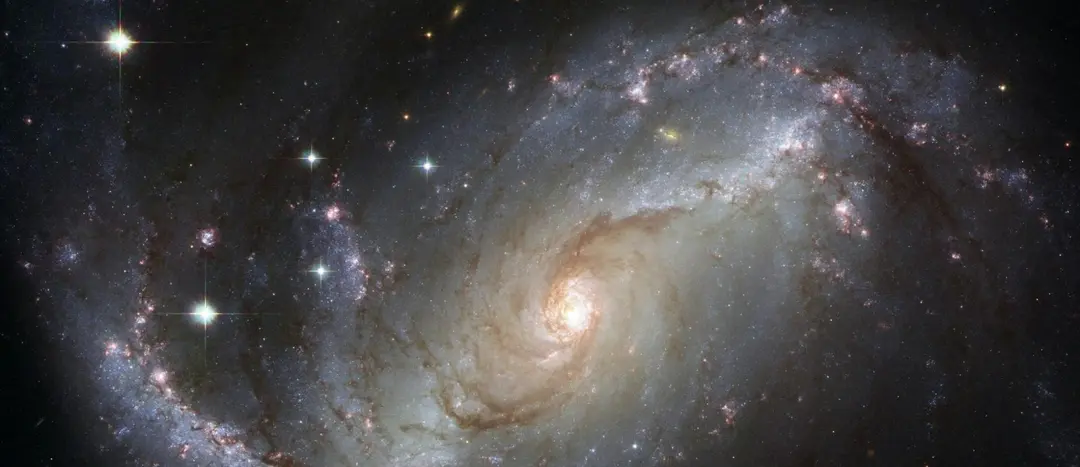
This Three-Body Problem reading reflection is not a brand-new blog post I wrote today, but rather a salvage operation on ideas from years ago. These contents were jotted down bit by bit in my iPhone Notes app in February 2017 while I was reading The Three-Body Problem. The original draft was roughly 11,000 characters; after transcribing and expanding it, it now stands at about 13,000 characters.
Back then, I wasn’t sitting at a computer typing seriously. Instead, I used voice-to-text, dumping whatever came to mind straight into the notes. The original recordings have long since vanished; all that remains are the transcribed texts from that time. The speech recognition accuracy back then was far lower than today, with a high error rate. Many passages are fragmented, disjointed, or even look like gibberish at first glance. But precisely because they weren’t “rewritten” later, but were spoken and recorded on the fly, they preserve something of the raw shock of that first reading.
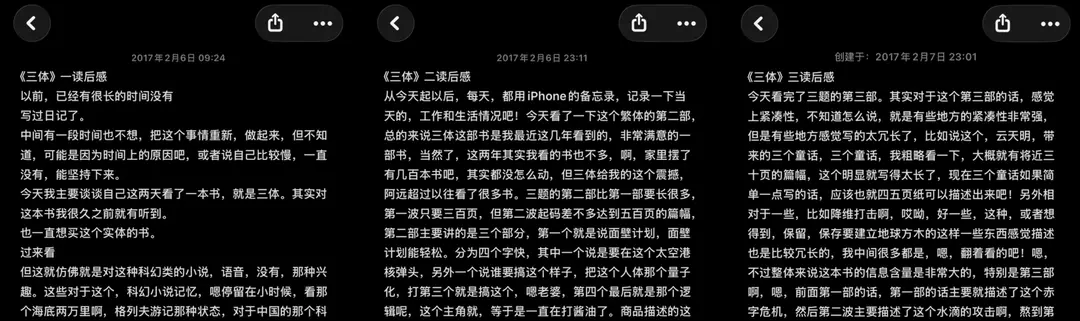
Looking back now, the fact that these words can see the light of day again feels somewhat miraculous: if iCloud sync hadn’t preserved the old notes, and if I hadn’t been able to use AI today to help restore some of the broken sentences, these pieces would probably have been lost forever.
So this article is not just a reading reflection on The Three-Body Problem; it is also a reOrganizing reading traces from many years ago. It is neither purely “today’s me” writing a commentary for the present, nor a verbatim copy of those error-filled voice transcripts. Instead, it tries to strike a balance between the two: staying faithful to the original thoughts while making them readable and fluent today.
Why I Started Writing Again Back Then
During the period when I was reading The Three-Body Problem, I had actually gone a long time without seriously writing blog posts. It wasn’t that I never thought about “writing something again,” but I never stuck with it. In the end, it was partly a matter of time, partly plain laziness, and more importantly, because I was typing so much at work that I developed an instinctive aversion to “writing anything more.”
This also explains why my blog updates became fewer and fewer, and why I eventually filled the gaps by posting pictures or scattered fragments. It wasn’t that I had nothing to say; typing itself had started to disgust me.
Later, one day, I slowly discovered that voice input suited me perfectly. Especially on the iPhone and iPad, speaking directly was far easier than sitting down and typing word by word. At the time, I also compared several tools. Youdao Cloud Notes’ speech recognition, to be honest, was not as good as iFlyTek’s—more errors—but iFlyTek had strict limits: only thirty seconds without holding the button, and just one minute even if you held it. It always felt like you were being interrupted, and your train of thought broke easily. In comparison, although Youdao Cloud’s recognition was a bit worse, it was better for continuous recording. Its biggest problem was that it segmented too aggressively—almost every two or three seconds it would cut a new section—making later cleanup extremely troublesome.
But regardless, it was from that time onward that I slowly picked up the habit of “recording ideas” again. And the reading reflection on The Three-Body Problem was exactly what came out of that background.
Why I Decided to Read The Three-Body Problem
I had actually heard about The Three-Body Problem very early on and was never completely uninterested. But that interest was more like “I know this thing is famous and powerful, I should read it when I have the chance,” without ever actually acting on it.
My impression of science fiction novels had stayed stuck in childhood—Twenty Thousand Leagues Under the Sea, Gulliver’s Travels, that sort of feeling. As for Chinese science fiction, before reading The Three-Body Problem, I had almost no clear impression, let alone any anticipation. If I exaggerate a bit, my sense of Chinese sci-fi was even less defined than my sense of traditional imaginative literature like Journey to the West.
What really made me decide to read it was a long video about The Three-Body Problem I saw on Bilibili at the time. The video was over eighty minutes long and used montages and commentary to lay out the general story arc of the entire trilogy. Combined with the frequent discussions I saw on Zhihu, the book had developed a very special aura in my mind: it was hugely famous, highly praised, yet seemed extremely complicated—complicated enough that I always felt I couldn’t keep up right away, so I kept putting it off.
That night I originally planned to buy the physical book—after all, it was only a few dozen yuan, not expensive. But on a whim, I first found a PDF version someone had shared online, thinking that since I wanted to read it now, I might as well start immediately. As a result, I was almost instantly sucked in.
The Three-Body Problem Burst My Original “Worldview” Wide Open
The first shock I received while reading the first book wasn’t any specific plot point, but a very direct feeling: it suddenly pushed my previous understanding of “how big the world can be imagined” outward.
We Chinese are not lacking in “grand” world imaginations. From Pangu creating the heavens and Nüwa patching the sky, to the cosmic order, reincarnation of all beings, and the systems of gods and Buddhas in Buddhism and Taoism, traditional Chinese culture has always had a complete set of ways to explain the universe and life. Journey to the West may look like a gods-and-demons novel on the surface, but the hierarchy of the Heavenly Court, the Buddhist realm, the demon realm, and the mortal world—how ranks are arranged, who stands where—is essentially a quite complete world structure.
But The Three-Body Problem is different. It doesn’t expand the world in a mythological sense; instead, on the foundation of modern cosmology, it rebuilds a cosmic panorama that far exceeds everyday experience. It doesn’t tell you how many gods are in the sky, nor does it speak of another mysterious kingdom beyond the world. It says: the universe we live in may itself be far more complex than the world we are accustomed to understanding. Multiple universes, small universes and large universes, dimension changes, cosmic reincarnation, the rise and fall and restart of civilizations… Once these things are strung together, you suddenly feel that much of what you once thought was already grand imagination was still, in many cases, revolving around “humans.”
One of the most powerful things about The Three-Body Problem is that it does not place humanity at the center of the universe to tell its story. Instead, it first acknowledges the universe’s vastness, indifference, and complexity, then turns around to examine what humans really amount to within it.
Why the Universe Is the Way It Is
Some Western science fiction I had encountered before—especially films—often felt quite limited to me. The most common trope was: an alien civilization arrives, either invades Earth or threatens humanity, then both sides fight fiercely, and the story basically ends after the battle. No matter how large the background, it essentially revolves around a war, a crisis, or a conflict.
Even some works with rich settings, in my view, rarely reached the scale of The Three-Body Problem. For example, Harry Potter has a world that is certainly not small, but ultimately it’s still just a few races, a few powers, and a few main storylines; its narrative grandeur is not on the same level as The Three-Body Problem. Or take many typical Hollywood sci-fi blockbusters—they may look like the sky is falling and the universe is at war, but they’re still fundamentally about “the enemy has come, how do we fight back,” rarely touching on “the truth of the universe” itself.
Of course, that doesn’t mean the West has no higher-level science fiction. Works like 2001: A Space Odyssey also discuss human origins and civilizational leaps. But overall, they lean more toward imagery and philosophical atmosphere. In contrast, The Three-Body Problem feels to me like it doesn’t just touch these questions occasionally; from beginning to end it is trying to explain why the universe is the way it is, why civilizations develop this way, and exactly where humanity stands within it.
It doesn’t use the universe as a backdrop to tell a story; instead, through the process of telling the story, it gradually pushes certain fundamental laws of the universe in front of you. This is the biggest difference between it and many ordinary science-fiction works.
Chinese People Can Also Create a “Modern Cosmic Myth”
Later, when I thought back, one very important reason I found The Three-Body Problem especially shocking was that it made me realize for the first time, very strongly: Chinese people can completely write a grand, self-consistent cosmic narrative that belongs to the modern world.
The grand narratives we were familiar with in the past mostly started from history, mythology, religion, or ethical order. Buddhism, Taoism, Journey to the West, the Fengshen system—these things are certainly huge and complete, but they remain grand narratives within the language of traditional culture. The Three-Body Problem is different. On the foundation of modern science, cosmology, and civilizational theory, it builds an entirely new “mythic structure.”
I use the term “modern cosmic myth” not to say it departs from science, but because it possesses the same kind of power that only myths have: it explains the world to you, explains order, explains life and death, explains reincarnation, explains fate—except it uses civilizations, technology, dimensions, and cosmic laws instead of gods and Buddhas.
This surprised me greatly. In the past, if someone asked who in Chinese literature could make the world feel especially vast, the first things that would come to my mind were still the classical works. But The Three-Body Problem made me realize that in today’s context, Chinese people can also retell “how big the world is” without using mythic language—using science fiction, cosmology, and the scale of civilization—and do it with great persuasiveness.
It’s Not Just Because the Sci-Fi Setting Is Brilliant
I’ve always felt that the reason The Three-Body Problem caused such a huge stir abroad is, first and foremost, because the book itself is genuinely strong: strong setting, grand scope, astonishing imagination, and internal logic that largely holds together. But beyond that, there are other elements inside it that probably caught the attention of overseas readers—especially Western readers—particularly easily.
One very obvious point is that it uses the background of the Cultural Revolution to open the entire story. This choice is, of course, first and foremost literary—providing sources for character development and historical trauma—but it also naturally carries a layer of “letting the outside world see how China reflects on its own history.” Western readers are often very willing to see Chinese works present and reflect on humanity and political trauma under extreme historical conditions; I think this is an objective fact.
Of course, this does not mean that The Three-Body Problem’s value relies on this to stand. Quite the opposite—I believe the book truly holds up because it is solid enough in itself. But if we’re talking about why it gained extra attention in its overseas spread, this layer of displaying China’s historical shadows and extreme states of humanity is indeed a very real reason.
The Real Core of the First Book Is Ye Wenjie
If we look only at narrative structure, Wang Miao is naturally the main viewpoint character in the first book; many mysteries and settings unfold gradually through him. But if I had to say who the true core figure of the first book is, I would still say it is Ye Wenjie.
Wang Miao is more like the person who brings the reader into this world—a thread, an entrance—while Ye Wenjie is the real spiritual center of the entire first book. Because the crisis begins with her, and the deepest ethical questions are concentrated on her. She is not an ordinary “villain,” but a person who, in an extreme historical environment, is gradually pushed to the point of completely denying humanity.
The novel uses the Cultural Revolution to shape her, not as a simple historical smear, but by placing the first half of her life in a context where humanity is extremely torn apart. In that environment, family bonds, knowledge, dignity, and order can all be easily destroyed. It is not entirely incomprehensible that a person would lose faith in humanity and even reach the point of “since humans are so unworthy, let’s destroy them all together.”
What I find most powerful about The Three-Body Problem in Ye Wenjie’s character is this: it does not rush to judge whether she is right or wrong. Instead, it first lets you see how her thinking grew. She did not go mad for no reason; she reached complete despair toward the entire human civilization only after experiencing extreme human evil.
Ye Wenjie “Makes Decisions for the Entire Earth”
Of course, understanding Ye Wenjie does not equal agreeing with her.
The extremity of her thinking lies in this: after losing faith in humanity, what she ultimately chooses is not “to distance herself from humanity” or “to change humanity,” but to expose Earth to a higher-ranking alien civilization. The problem with this choice is that it is no longer merely judging humanity, but deciding for the entire Earth.
Because Earth is not only humans. Even if humans are indeed evil and have done many ugly, cruel, even anti-human things, Earth still has other life forms and an entire ecosystem. If an alien civilization truly arrives, what it changes and destroys may not be only humans, but possibly the entire Earth’s biosphere. At this level, the question is no longer “whether humanity deserves destruction,” but “by what right do you decide the fate of the entire planet?”
This is also where I think The Three-Body Problem is very clever: it does not simply stay at the level of “human nature is evil, humanity deserves destruction,” but quickly pushes the issue to a higher ethical dilemma. Even if you are disappointed in humanity to the extreme, that does not mean you have the right to let all species go down with you.
In this sense, Ye Wenjie’s thinking is not even entirely the same as ordinary terrorism. Traditional terrorism often still has the goal of “preserving oneself or one’s own group,” whereas Ye Wenjie is more like a total negation that drags everyone down together. She is not destroying others to save herself; she simply no longer cares about herself either. This idea is extreme and terrifying, but precisely because of that, it feels complex rather than something that can be summed up as “she is just a bad person.”
Simulating How a Civilization Can Restart in Desperation
Another important thread in the first book is Wang Miao entering the “Three-Body” game. The novel spends quite a few chapters here, using several sections to unfold the game. On the surface, it looks a bit like a monster-slaying leveling-up routine: enter a world, understand the rules, fail, restart, level up bit by bit, and finally approach the real problem of that world.
But what makes this truly interesting is not the “game feel,” but that it actually uses a very intuitive way to simulate how a civilization repeatedly destroys, restarts, and evolves in an extreme environment.
The core dilemma of the Three-Body world is the disorder and disaster caused by its three suns. The planet has no stable orbit; civilization cannot slowly accumulate like Earth civilization in a relatively stable natural environment. Instead, it is often just starting to develop when it is thrown back by extreme climate and cosmic order. This means the evolution of Three-Body civilization is not linear, but cyclical. It does not steadily progress from the Stone Age all the way to the Information Age; instead, it is destroyed again and again, and each time it must somehow preserve the spark of civilization.
This setting is actually very powerful. Because it is not just to show off “I came up with such a strange planet,” but to use this planet to discuss a bigger question: what exactly does a civilization depend on to continue stably? If you throw a civilization into a completely unstable cosmic environment, what does it need to survive?
Many of The Three-Body Problem’s Imaginations Are Not Isolated
The specific setting in the Three-Body game that impressed me most was “dehydration.”
Compressing an originally three-dimensional person into a flat “human skin” in an extreme environment, then rehydrating and restoring them when the environment recovers—this setting was truly shocking the first time I saw it. On one hand it carries a certain absurdity; on the other, it perfectly fits the extreme survival conditions of the Three-Body world: if normal life forms cannot withstand the disaster, temporarily change form and survive first.
On the surface this looks like nothing more than a wild sci-fi idea, but the further I read, the more I felt it was not an isolated invention. Because in the third book, the dimensional strike, the two-dimensional foil, and the two-dimensionalization of the Solar System are all essentially related to this “dimensional change.” In other words, many of the most stunning settings in The Three-Body Problem are not random thoughts thrown in; they have underlying echoes with one another.
This point is very important. Because the problem with many sci-fi works is that they have lots of settings, but they are scattered; after reading, you just feel “the author has a big imagination.” The Three-Body Problem is different—many of its imaginations come back later and explain one another. Precisely because of this, it makes you feel you are not simply watching a few spectacles, but watching an increasingly complete cosmic structure.
How Could Communication Between Different Civilizations Be So Easy?
Of course, the first book is not without places that made me skeptical.
One issue I cared about from the beginning was communication between Earth and the Trisolaran civilization. This question may be very common in sci-fi novels; many works simply assume that once a signal is sent and received, the two sides can gradually start talking. But when I read it, I always felt this was actually extremely difficult—far more difficult than imaginable.
Forget alien civilizations—even on Earth, communication between different languages and cultures often requires long periods of learning, contact, and trial and error. Even between humans and animals, after so many years of coexistence, true “communication” is still very limited. So why should a civilization from a completely different planet, with a completely different perceptual system and evolutionary path, be able to establish a relatively smooth information-understanding relationship with Earth?
To go deeper, language itself is a problem. How do you send Chinese content to aliens so they can understand it? Their way of perceiving, expressing, and structuring logic may not be the same as humans’. Of course the novel cannot spend too many pages on this; otherwise the single issue of “how to understand each other” could support another whole book. Even so, this doubt remained with me.
However, I don’t think this undermines The Three-Body Problem at all. On the contrary, it is more like a reservation that naturally arises when I, as a reader, bring real-life experience to the text. Great works do not have to seal every question airtight; they mainly build an overall persuasiveness strong enough that even if you keep a few doubts in your heart, you are still pulled forward by the story.
Half-Believing, Half-Doubting—Yet Eyes Opened Wide
In the second half of the first book, several settings left very different impressions on me.
First, the Red Coast Base and Ye Wenjie’s storyline. This part is very important because it grounds the entire novel’s historical starting point, letting you know how the connection between Earth and Trisolaris actually happened. But here I instinctively felt that some specific technologies and communication methods were a bit too smooth. In other words, they work literarily and are necessary for the narrative to advance, but if you think about them carefully from a real technological perspective, they still feel a little “too fantastical.”
In contrast, the Sophon setting was the part that truly made my eyes light up. The novel says the Trisolarans unfold a proton into a higher dimension, process and etch circuits in higher-dimensional space, then fold it back, ultimately obtaining a Sophon that can move at high speed and interfere with Earth’s scientific experiments. The first time I saw this setting, I genuinely had a “mind blown” feeling.
It reminded me of the “big thing compressed into a tiny entity” imagination in some sci-fi movies, such as the AllSpark in Transformers—a very huge thing shrunk into a very small particle through some method. But the explanation The Three-Body Problem gives here feels more systematic: it doesn’t simply say “technology is advanced enough to shrink things,” but links it to dimensions and spatial structure. A three-dimensional object enters four-dimensional space, is unfolded, processed, then folded back into low dimensions—this way of explaining makes it feel not just a prop, but part of an entire cosmic view.
As for the later scene where humans use nano-wires to slice an entire cruise ship in half, I was half-believing at the time. Because once it involved real Earth technology, I would naturally measure it against “can this really be done in reality?” That passage was indeed very visual and impactful, but I still felt it was a bit fantastical. Even so, it had a very strong novelty. That is to say, I may not have fully believed how realistic it was, but I acknowledged that as literary and sci-fi imagination, it worked—and it was fresh enough.
The Logical Relationship of the Trilogy
After finishing the first book, I had a very strong feeling: it is certainly a complete novel in itself, but it does not feel like a fully closed, self-contained ending. It feels more like laying out a huge net, gradually planting the things that the second and third books will truly unfold.
This is actually quite interesting. You discover that many parts of the first book seem to still be at the starting point of the crisis, the unfolding of mysteries, and the throwing out of settings, yet many truly powerful elements—such as the later cosmic laws, the fate of civilizations, dimensional disasters, technological explosion, etc.—have already been subtly buried.
So at the time, while I felt that some parts of the first book had not fully connected to the grander scope of what followed, I also felt that the author had already planted many things in the first half. You may not be able to say clearly whether he had the entire sequel completely planned out at the time, but at least you can see that the groundwork is extremely solid. Whether it grew while being serialized or had a rough framework from the start, being able to write the first book this way and then connect it to such a huge scope is already very impressive.
The “Wallfacer Project” Idea Itself Is Admirable
By the second book, The Three-Body Problem’s scope suddenly becomes much larger than the first. The first book mainly establishes the crisis, builds the world, and sets up that unsettling connection between human and Trisolaran civilizations, while the second book immediately pushes the question to a deeper level: when Earth civilization already knows that it will almost certainly face a destructive threat in the future, what can humanity do?
The Wallfacer Project is proposed in exactly this situation.
When I first saw this setting, the first feeling I had was not “this method must be very effective,” but “the thinking behind it is already very impressive.” Because it seizes a particularly key point: when an alien civilization is highly advanced, Sophons have locked Earth’s basic science, and they can observe human society in various ways, what advantage does humanity still have? The answer turns out to be not technology or weapons, but the opacity of thought itself.
In other words, the last thing humanity can rely on may not be greater power, but “you don’t know what I’m really thinking.”
This point is very clever. It instantly elevates war from the physical level to the cognitive and psychological level. The Wallfacers do not save the world by building a bigger weapon, but by keeping a plan in their own minds that others cannot fully decipher for the time being. This setting made me feel for the first time that The Three-Body Problem is not simply escalating enemy confrontation, but constantly delving into the essential question of “how civilizations fight each other.”
The Aliens Are Not Fighting Humanity Alone
Of course, the reason the Wallfacer Project feels both brilliant and cruel from the beginning is that it buries a huge loophole: the Trisolaran civilization is not a purely external force fighting humanity in isolation. It has organizations, supporters, sympathizers, and rebels on Earth—and those people are themselves human.
This point is very crucial. Because if the enemy were purely alien observers, then “the opacity of human thought” could indeed be a final barrier. But the problem is that what can truly crack human behavior, emotions, habits, and psychological patterns is often not the aliens, but precisely other humans living in human society.
In other words, the greatest enemy of the Wallfacer Project is not necessarily the Trisolaran civilization itself, but “humans helping to see through humans.”
So looking back, many of the Wallfacers’ failures were not because their ideas had no value, but because they ultimately could not escape being part of human society. Every move you make, every word you speak, every gesture, every long-term behavioral pattern you display will be repeatedly interpreted and dissected by others. The Trisolarans may not see through all the plans in your brain, but those people standing beside you, who are familiar with the rules of human society, may very well gradually force them out.
In this sense, the Wallfacer Project actually carries a strong tragic quality: the smartest solution humanity finally came up with may very well first be destroyed by humanity itself.
Why the Dark Forest Law Is So Shocking
The real core of the second book is, of course, Luo Ji and the Dark Forest Law that is ultimately fully revealed.
Many people feel that once this law appears, it is as if the entire book is suddenly split open by a bolt of lightning—everything instantly makes sense. I certainly had that strong feeling the first time I encountered it: the chill of “so the universe may not operate on a logic of cooperation at all, but on a logic of hiding and hunting” is truly unforgettable.
But looking back, I also feel it is not an entirely out-of-the-blue conclusion. Because in the first book, Ye Wenjie had already given some very important hints in advance; they just hadn’t been fully unfolded at the time. Concepts such as the chain of suspicion and technological explosion are not completely unimaginable either. Once you accept that it is very difficult for civilizations in the universe to establish real trust, and that technological development can explode in a very short time, then the conclusion of “hide first, stay vigilant, and strike first when necessary” is already lurking in the shadows.
So the most powerful thing about the Dark Forest Law is not that it is completely unexpected, but that it suddenly turns those scattered anxieties and scattered hints into an extremely cold yet almost complete logical chain.
What truly makes this law chilling is: it makes too much sense. You may not want to accept it, but it is very hard to casually refute it. Because once you look at it from the cosmic scale, the relationship between civilizations may not naturally tend toward understanding and cooperation as humans imagine. On the contrary, in a situation of scarce resources, opaque information, and extremely rapid technological leaps, hiding and eliminating may be more in line with “rationality.”
Are Humans in the Doomsday Still “Human”?
Besides the Dark Forest Law, another part of the second book that struck me hard was its depiction of doomsday society.
What impressed me deeply here is that when civilization truly faces the risk of extinction, the very concept of “human” changes. Or rather, a person who was originally constrained by morality, law, and ethics within an Earth community, once truly detached from Earth and from the original community, may no longer be the same kind of “human” in the original sense.
This may sound a bit extreme, but that is exactly the feeling the novel gave me. As long as you still maintain direct contact with Earth—like a kite that has flown far but the string is still tied to the ground—you still belong to Earth society and are still bound by those rules. But if one day Earth is gone, or your connection to Earth is fundamentally severed, you become a separate small world, a new kingdom. At that point, the morality, law, and ethics originally built on the Earth community begin to fail.
In other words, human morality does not exist in a vacuum; it has a strong material and environmental foundation. This also makes me think of ideas like “matter determines consciousness.” Under what survival conditions you live, you are more likely to form what kind of consciousness structure. When Earth still exists and humanity is still a whole, morality can hold; but once you reach the stage of civilizational doomsday, extreme scarcity of survival, and having to seize the last chances, people may quickly regress to a more primitive, colder state.
I feel that on this point, The Three-Body Problem goes deeper than many ordinary doomsday works. It does not simply say “doomsday comes, human nature turns bad,” but reminds you: much of the civilization we think exists naturally is actually attached to a specific community and survival environment. Once that foundation disappears, no one dares to guarantee what people will become.
The Third Book’s Information Density Is “Too Packed”
The third book, Death’s End, gave me the overall feeling that its information volume far exceeds the first two. The first book mainly establishes the Trisolaran crisis and the world framework; the second pulls up key structures such as the Dark Forest, the Wallfacer Project, and the droplet attack; but by the third book, the entire work suddenly leaps from the “Earth–Trisolaris” bilateral relationship directly to a larger cosmic-civilization scale.
Dimensional strikes, two-dimensional foil, curvature propulsion, lightspeed ships, pocket universes, cosmic laws, cosmic restart… these things pour out almost in heaps. The reading experience it brings is, on one hand, extremely shocking—because you clearly feel that this work is no longer satisfied with discussing a particular civilizational conflict, but wants to discuss the basic operating rules of the entire universe; on the other hand, it does make you feel that some parts are overly packed.
I felt very directly at the time that Yun Tianming’s three fairy tales were too long and could have been more concise. Some parts about civilizational backup, preserving the spark, and later arrangements, I actually skimmed. Not that they are unimportant, but the overall information density of the third book is so high that you feel your brain is constantly being forced to expand capacity. In some places, when it is written too meticulously, the reading rhythm even drags a bit.
Even so, it still stands. Because the truly powerful thing about the third book is not that every part is extremely tight, but that it finally fully opens the truth the entire series has been approaching: Earth civilization and Trisolaran civilization, which already seem grand enough, may still be only a very elementary layer when placed in the larger scale of cosmic civilizations.
Cheng Xin Is More Like an Ordinary Person in a Cosmic Predicament
In online discussions about The Three-Body Problem, there are a lot of people scolding Cheng Xin. Many people mention her and immediately say “saint,” “everything bad happened because of her,” “she missed two opportunities,” “destroyed Earth and then destroyed the universe,” and so on. But if you really follow the novel itself, I think it is not that simple.
The first time Cheng Xin faces a truly unsolvable predicament is when she takes over from Luo Ji as Swordholder. The position itself means: you hold a deterrence power in your hands; once you press the button, you expose the locations of both Earth and Trisolaris, almost equivalent to sending both civilizations into the Dark Forest together. But if you don’t press it, it may mean Earth loses its last deterrence capability and is suppressed or invaded by Trisolaris. In other words, this is not a simple “press and you’re right, don’t press and you’re wrong” choice, but a situation where no matter which way you choose, disaster may result.
In this situation, if Cheng Xin presses the button, she can immediately be regarded as the great demon who destroyed Earth; if she doesn’t press it, the consequences may also be extremely serious. Moreover, the reason she stood in that position is itself the overall choice of Earth civilization at the time. You cannot on one hand appoint a person who represents all of humanity’s ethical expectations to take this position, and on the other hand demand that at the critical moment she must act like someone who has completely abandoned human ethics. This is inherently contradictory.
The second time is similar. When it comes to issues such as curvature propulsion, lightspeed flight, civilizational escape, and technological disclosure, what she faces is not a clear game, but a problem with insufficient information, extremely severe consequences, and involvement in the entire internal order of humanity. At that time, it was widely believed that if curvature propulsion were rashly developed, it would very likely expose Earth’s location and invite higher-level Dark Forest strikes; on the other hand, if a minority grasped this technology first, it could also cause new tears within civilization—conflict between those who could fly away and those who could not. No matter who you give such a problem to, it is not something that “being a bit smarter can solve.”
Overall, if I have to say Cheng Xin has a saintly heart and deliberately put Earth in danger, I think that is unrealistic, because in her environment, based on the judgment at the time, it cannot be said that she was wrong. As for the later discovery that simply having a few thousand ships with curvature propulsion start at the same time could form a black domain around the Solar System and hide it—this was something that could only be discovered after later technological development; you cannot blame her. In fact, Cheng Xin already did a lot in the whole story. For example, in the communication with Yun Tianming, two of the three fairy tales were directly deciphered by Cheng Xin’s side. As for the hardest one—the one about the two-dimensional foil—in that situation at the time, it was hard to expect an ordinary person to figure it out. This kind of dimensional strike was something no one could have anticipated; only after humanity had actually seen something similar happen would they know that such a powerful thing existed in the universe.
So I prefer to see Cheng Xin as a sample: she is not simply “the wrong person,” but the key character The Three-Body Problem uses to show “normal human ethics in society become ineffective under extreme cosmic conditions.” What she fails is not her conscience, but humanity’s original scale.
The Ruthless Gap Between Cosmic Civilization Levels
Throughout the entire Three-Body Problem, the plot that made the chill finally settle deep in my bones was still the two-dimensional foil strike on the Solar System.
The Dark Forest Law is more of a logical coldness, while the two-dimensional foil is an almost concrete coldness that makes you tremble. Because at that moment you suddenly understand: Earth civilization spent so long, experienced so many technological leaps, and had even begun to approach lightspeed flight, curvature propulsion, and dimensional experience—abilities that once seemed like myths—but in front of a higher-level civilization, it still could not even count as a proper confrontation.
The harshest point in the book is how lightly it treats the character who carries out this act. The other side is not some awe-inspiring, arrogant cosmic overlord, but merely an extremely humble, ordinary cleaner in Singer civilization. With a casual flick, a very small two-dimensional foil is thrown out, and the entire Solar System is dimensionally destroyed. Although Earth, after the sun was struck, prepared to continue hiding, and although Earth civilization had already developed to a very high level—having gone through several technological explosions and achieved very great results, mastering lightspeed flight, curvature propulsion, and even truly experiencing the transition from three dimensions to four dimensions—it was still casually destroyed by a cleaning worker in Singer civilization with an almost random action. Just as the book says: “To annihilate you has nothing to do with you.”
This dramatic quality is very strong, but precisely because it is strong, it feels even more terrifying. The civilization you painstakingly built, your history, your wars, your ideals, your scientific breakthroughs—in the eyes of a higher-level civilization, may not even be worth being taken seriously. It is not “you can’t beat me,” but “you are not even qualified for me to treat this as a formal conflict.”
The feeling of “To annihilate you has nothing to do with you” is almost pushed to the extreme here.
The Handling of “Technological Explosion” Speed Is Shocking
Looking back, another place in The Three-Body Problem that left a very deep impression on me is its description of “technological explosion,” which almost reshaped my understanding of civilizational time scales.
If we look at the entire species history of humanity, we have already existed for a very long time; if we count from complete civilization history, it has been several thousand years. But The Three-Body Problem made me feel for the first time, very intuitively: for true cosmic civilizations, a few thousand years may not count for anything at all, and once entering the technological explosion stage, change can become frighteningly fast.
The Trisolaran civilization in the novel is a typical example. At the very beginning, we know that the first fleet that flew out actually had very low speed—less than even a small fraction of lightspeed. But looking further, in just one or two hundred years, they had already achieved completely different levels of technological leaps. Earth civilization is the same: it originally seemed to be struggling bitterly, yet in the following short few hundred years, it also rapidly came into contact with abilities that were once unimaginable.
In other words, the development of civilization is not necessarily uniform forward progress. It may accumulate slowly for a long time, then suddenly leap upward at a certain stage. This also exactly explains why the Dark Forest Law is so effective: because on the cosmic scale, you cannot use today to judge whether a civilization will still be weak a few hundred years later. A few hundred years is very long for humans, but for the universe it may be an almost negligible instant.
This is also why The Three-Body Problem increasingly makes you feel that many of humanity’s judgments about the universe today are actually very elementary. Not because we are not working hard enough, but because we may not even have truly understood “how civilization will actually change.”
A Warning for Humanity’s Future Space Exploration
I have always felt that the most valuable thing about The Three-Body Problem is not that it simply gave people many spectacles, but that it forces people to rethink: if the universe is really like what it says, then how should humanity face the universe in the future?
There is a very important point in the book, mentioned in Yun Tianming’s final recollection: if Earth had no life, then it would have no essential difference from other dead planets. What truly changes the face of a planet is life itself. But the problem is, once you acknowledge that life is not a particularly accidental or unique existence in the universe, you must also acknowledge: there may be far more than Earth that has life in the universe, and there may even exist civilizations far more advanced than us that we simply cannot detect.
At this point, the kind of vigilance The Three-Body Problem proposes becomes very real. The reason we cannot see them today is not necessarily because they do not exist, but possibly because they have long mastered the means to hide themselves. Just like stealth fighters on Earth—you cannot conclude that nothing is there just because conventional radar cannot see them. Once civilization develops to a higher stage, it can completely hide and disguise itself in ways we fundamentally cannot recognize.
From this angle, The Three-Body Problem does affect people’s imagination of future space exploration. It is not necessarily persuading people not to explore the universe, but reminding them: do not too lightly assume that the universe is safe, transparent, and empty. And do not too lightly regard “speaking to the universe” as a naturally romantic act. Perhaps on a larger scale, this behavior itself may carry enormous risk.
A Cornerstone-Level Science-Fiction Novel
If I must say, The Three-Body Problem is of course not without problems. Some communication settings in the first book make people skeptical, the climax at the end of the second book comes too abruptly, and some parts of the third book do feel overly packed and lengthy. Even certain technical descriptions, if you are particularly nitpicky and question them, are not completely free of flaws.
But these problems do not prevent me from regarding it as a truly important work.
Because what makes it truly powerful is not whether the details are 100% perfect, but that it establishes an entire grand, self-consistent, and sufficiently thought-provoking ideological structure. It is not simply stacking a few very cool ideas; it lets these ideas support and explain one another, ultimately forming a very complete sense of cosmic oppression.
This is also why I feel it fully deserves evaluations such as “classic” or even “cornerstone-level science-fiction novel.” It is not just telling a story about an alien civilization and human civilization, but constantly forcing you to reunderstand more fundamental things: civilization, human nature, morality, technology, cosmic rules.
The Lingering Shock Years Later
Now, reorganizing these voice-to-text remnants left many years ago, I can clearly feel: the me at that time actually did not have as many clear, mature expressions as I do now. Many judgments jumped around, many places were thought and spoken at the same time, and many sentences were not even smooth. But precisely because of that, they preserved something that is very hard to replicate later—the feeling of having your sense of the world suddenly and completely expanded by a book for the first time.
That feeling is not simply “thinking the book is good,” but suddenly realizing that humanity can be placed in such a large scale for viewing, that civilization can be understood within such a cold logic, and that the universe can be not a romantic background, but a structure that shows no mercy to anything.
Many years later, when I reorganize these remnants again, I am of course no longer in the same reading state as back then. Yet I can still see the shock of that moment from these drafts. For me, the truly precious thing about The Three-Body Problem is exactly here: it did not merely provide one reading experience, but left a very clear coordinate in a person’s thinking.
Many years later you may forget the specific plot, forget some names, even forget which device you first read it on, but you will remember that the first time you truly realized “the universe may not operate according to human imagination at all” was very likely when you read The Three-Body Problem.
The Three-Body Problem Forces Humanity to Reunderstand Itself
Overall, The Three-Body Problem has already become more than just a particularly good science-fiction novel in my heart.
What makes it truly powerful is that it does not use the universe as a backdrop to tell a legend, but constantly forces the reader to rethink: what exactly do humans count as? What exactly does civilization depend on? Under what conditions does morality hold? Is technology salvation, or exposure? If the universe fundamentally does not operate according to human scale, then how much of the judgments we are familiar with can still remain?
It does not give a standard answer; it gives you a new scale.
And once you accept this scale, many things become different. When you look again at human history, civilizational conflicts, technological development, and space exploration, you will subconsciously think one more step: if you put all this against a larger cosmic background, what exactly does it mean?
If some novels merely finish telling a story, then The Three-Body Problem is more like opening a crack in a person’s brain.
Looking out from this crack, the world does not necessarily become gentler, but it certainly becomes vaster—and more unsettling.
And that is exactly its most fascinating part.