Why Did That Official Automotive Quality Regulatory Platform 'Disappear' from This Public Discourse?
Recently, because I was following some hotly debated automotive quality controversies online, I revisited the China Automotive Quality Network website. The last time I seriously looked at this website was probably 10 years ago. At that time, my first car developed an air conditioning failure just a few months after I bought it. After negotiations with the 4S dealership went nowhere, I filed a complaint on this website and only then did the issue get resolved. From that, I also developed trust in this official automotive quality regulatory platform.
But looking at it again this time, the feeling was completely different.
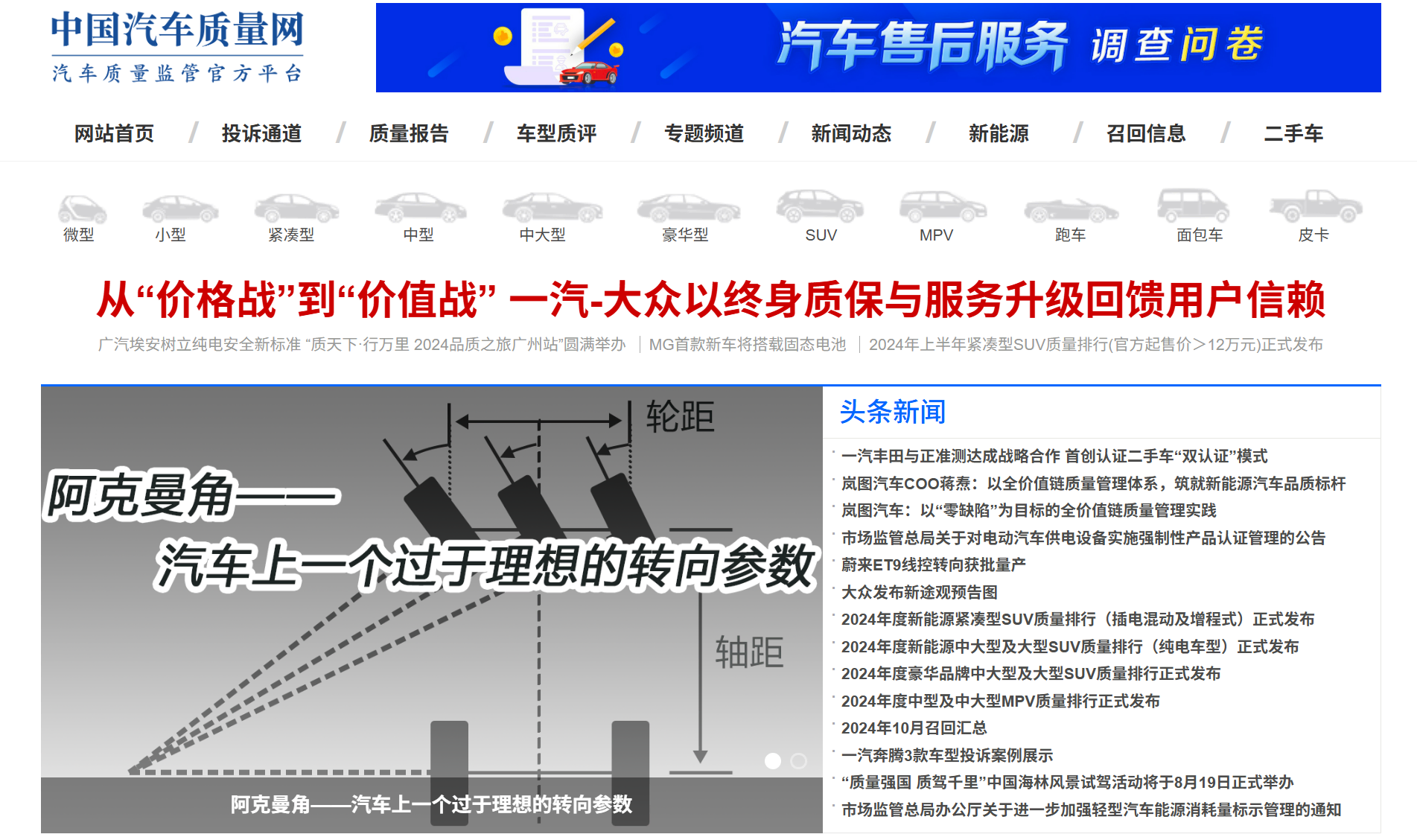
The website's homepage headline was still stuck in 2024. The new car review section mixed test-drive articles from 2022 with teardown reports from 2026. And in the column called "Vehicle Quality Comparison," the latest article was "Changan Ford: Not Competing on Price, Competing on Standards!"—an obvious automaker slogan, copied over word for word.
But on the same website, the complaint platform was still running normally. I skimmed through it roughly: on October 10, 2026 alone, about 120 new complaints were added, and more than 50 were accepted by manufacturers. In the latest records from October 12, there was a complaint about a BYD Han EV suddenly losing power on the highway and being unable to shift gears, a complaint about a BAIC New Energy EV200 battery pack leaking fluid and suspected electrolyte leakage, and a complaint about a Bestune Pony losing steering after only 12 days of ownership and swerving into oncoming traffic.
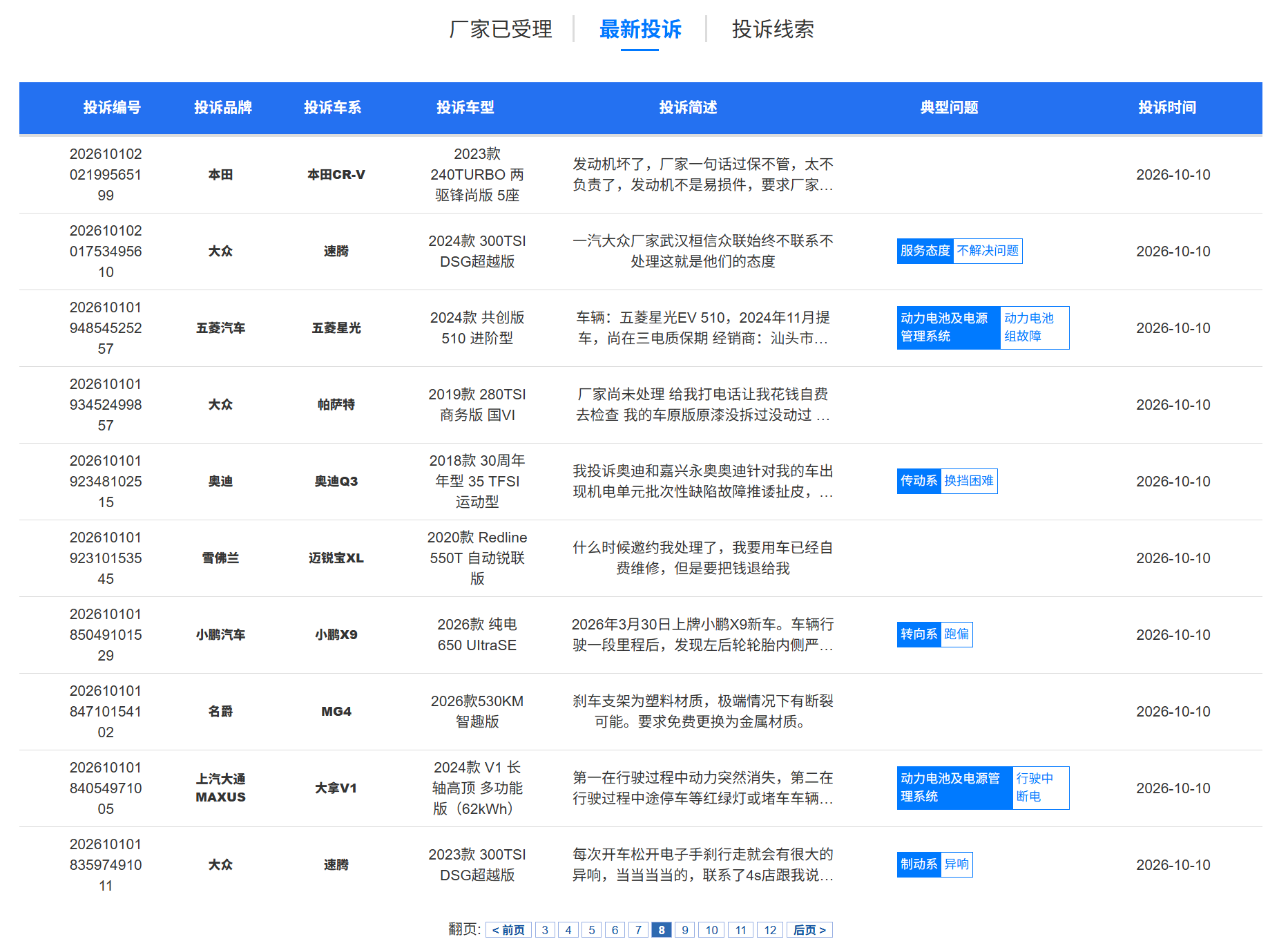
On one side are safety leads updated in real time; on the other are reviews from years ago and automaker press releases. This sense of rupture made me want to dig deeper into the problems behind it.
Who It Is
First, let's make the identity of this platform clear.
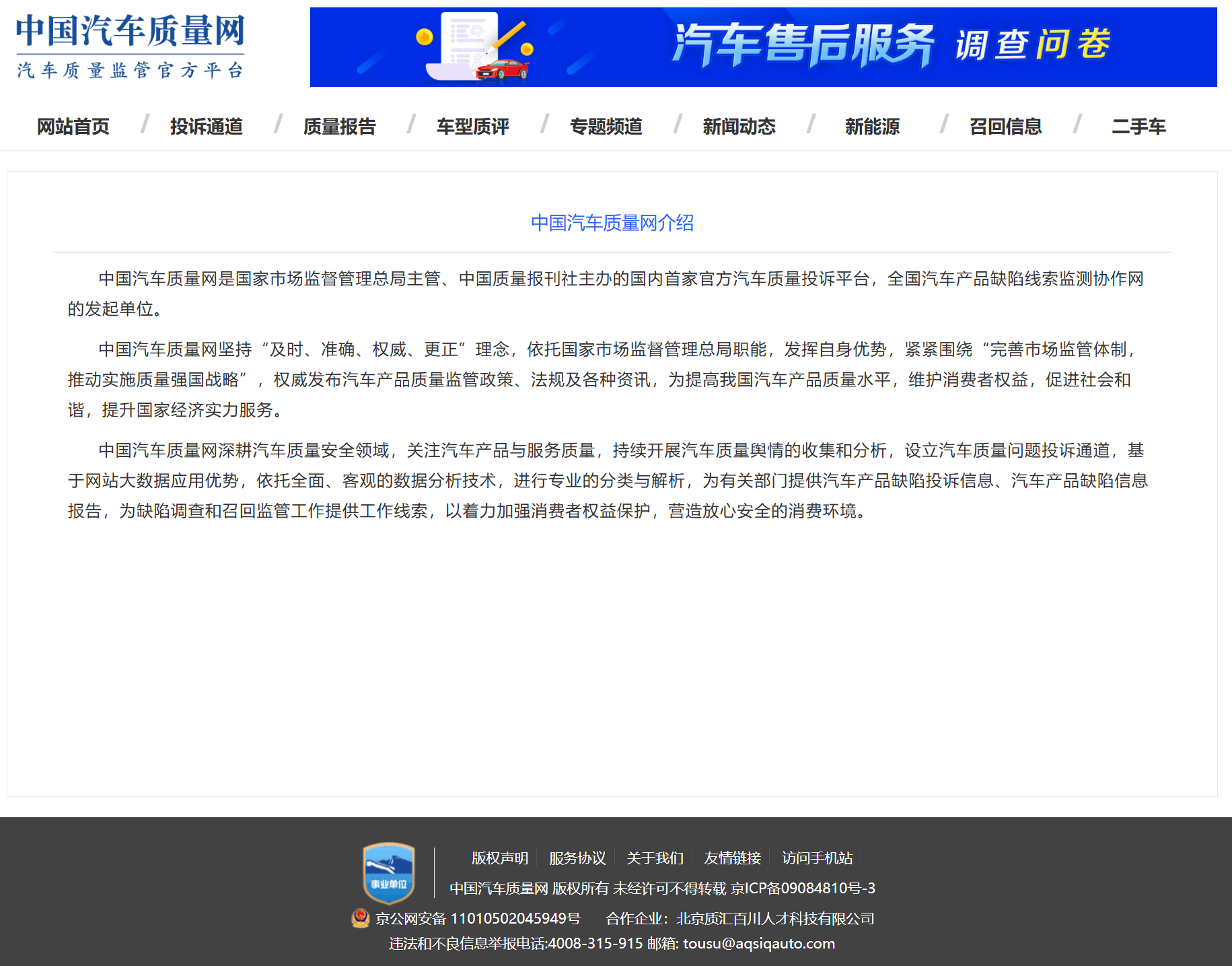
China Automotive Quality Network (aqsiqauto.com) is supervised by the State Administration for Market Regulation and hosted by China Quality News Press. It is the initiating unit and one of the first member units of the "National Automotive Product Defect Clue Monitoring Collaboration Network." This collaboration network was initiated by the Defective Product Recall Technology Center of the State Administration for Market Regulation. Its core function is to form defect reports by collecting consumer complaint information and provide recall investigation leads to regulatory authorities.
In other words, the backend data of this website can, in theory, enter the view of the National Defective Product Recall Technology Center and become the basis for launching a defect investigation. This is the source of its "authority," and also the confidence behind its labeling itself in the most prominent font on the homepage Logo as "Official Automotive Quality Regulatory Platform."
Yet the other information on its homepage makes it hard to feel that authority. The headline news is "FAW Toyota and Zhengzhunce Reach Strategic Cooperation," the review section features test-drive experiences of GAC Toyota Venza and Honda Integra, and the vehicle quality comparison section features Changan Ford's brand promotion "Not Competing on Price, Competing on Standards." An official platform whose core function is collecting defect clues presents itself to the public as an "automotive media outlet" with outdated content, chaotic standards, and a flood of commercial press releases.
Institutional Design Determines That It Should Not Have "Volume"
To understand this platform's dilemma, one must return to its institutional design itself.
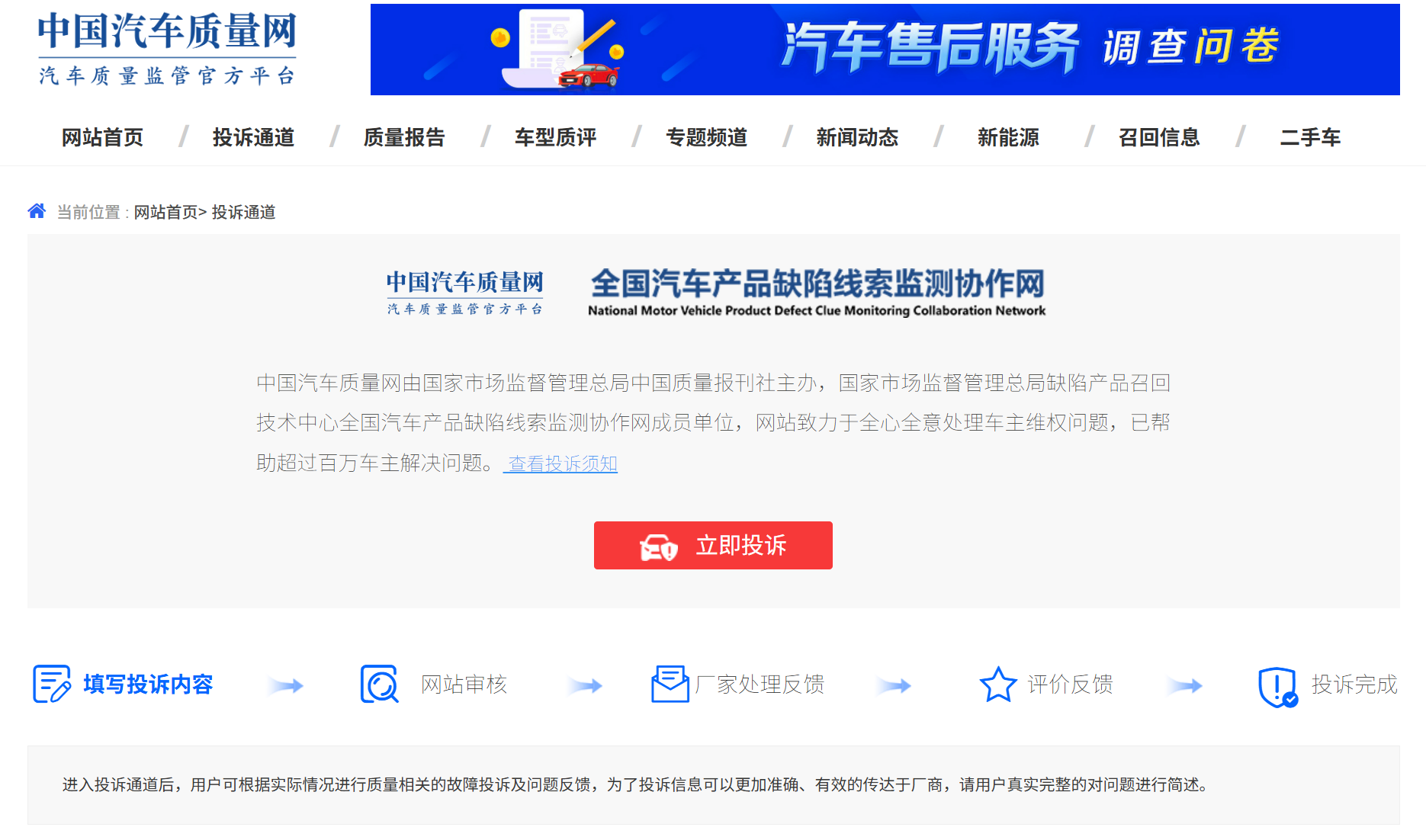
On the website of the Defective Product Recall Technology Center, there is a page explaining "defect clue reports." The text is plain, but highly informative:
"A defect clue report is, in full, a report by a consumer regarding a product that may have a defect. The defect clue report you submit will serve as an important source of information for us in comprehensively determining whether a product has a defect."
This page also uses a long passage to explain "what is a defect": a situation caused by design, manufacturing, labeling, or other reasons, in which products of the same batch, model, or category generally have conditions that do not meet national or industry standards for ensuring personal and property safety, or other unreasonable dangers that endanger personal and property safety. The processing flow is: consumer submits → center evaluates → if passed, enters the database → requests enterprise confirmation → conducts defect analysis in accordance with regulations.
The most crucial part is the final disclaimer:
"Due to the limits of our work responsibilities, we may not be able to respond to every report, nor can we mediate consumer disputes, compensation for losses, or mediation work outside the scope of the 'Regulations on the Administration of Recall of Defective Automobile Products' and the 'Interim Provisions on the Administration of Recall of Consumer Goods.'"
This passage draws the boundary in the most direct language: it does not handle individual disputes, only batch safety defects; it does not respond to every report, only conducts backend analysis; it does not mediate compensation, only determines whether a recall is needed.
This is not "dereliction of duty," but the institutional design itself. The logic of the defective product recall system is to collect enough leads, prove that a certain problem "generally exists in the same batch," and then initiate statutory recall procedures. A single consumer complaining that a 4S dealership has a bad attitude, fails to honor commitments, or delays repairs is essentially outside the scope of this system.
Therefore, when a hot event triggered by commercial media sparks discussion across the internet, this platform's "silence" is an institutional inevitability. Its way of working is not to comment on hot events, but to wait for real car owners to submit defect clue reports, and after accumulating a certain amount, form analytical conclusions.
The Rupture Between Front End and Backend
But the problem is that this platform is not content to be only a "backend data tool."
It once tried to be an automotive quality media outlet facing the public. Thus came the "New Car Review" section, the "Vehicle Quality Comparison" column, and various test-drive activities. It is just that the production logic of this content fundamentally conflicts with its core function.
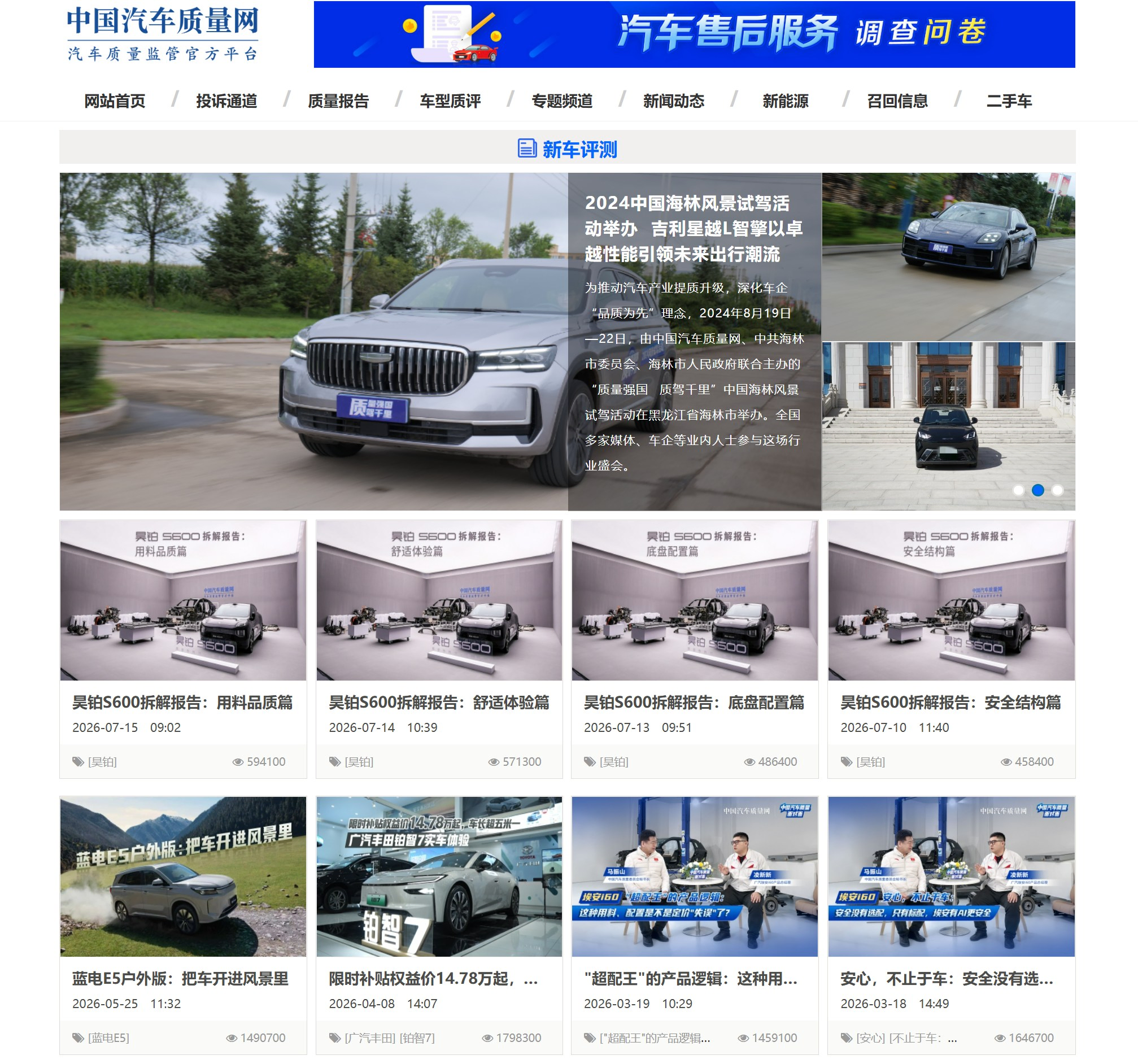
The content of the "New Car Review" section can be seen as problematic just from the titles. "2024 China Hailin Scenic Test Drive Event Held: Geely Xingyue L Hi·P Leads the Trend of Future Mobility with Outstanding Performance"—this is clearly an event press release. The organizer was China Automotive Quality Network itself, and under the same event, GAC Toyota Frontlander, Jetta VS5, and Porsche Panamera each got an article, all with identical title formats. "Hao Bo S600 Teardown Report: Materials Quality Chapter/Comfort Experience Chapter/Chassis Configuration Chapter/Safety Structure Chapter"—four articles published in succession, intensive, segmented, and positively oriented, a typical deep cooperation project.
The "Vehicle Quality Comparison" column is even more direct. The section is called "Vehicle Quality Comparison," but not a single article in it is a real comparison. "Prado Successor Toyota Land Cruiser '250' Makes Global Debut" is new car launch news. "Changan Ford: Not Competing on Price, Competing on Standards!" is an automaker slogan. "From 'Marching Toward the World' to 'Global Classic': The 50-Year Persistence and Evolution of the Accord" is a brand history retrospective.
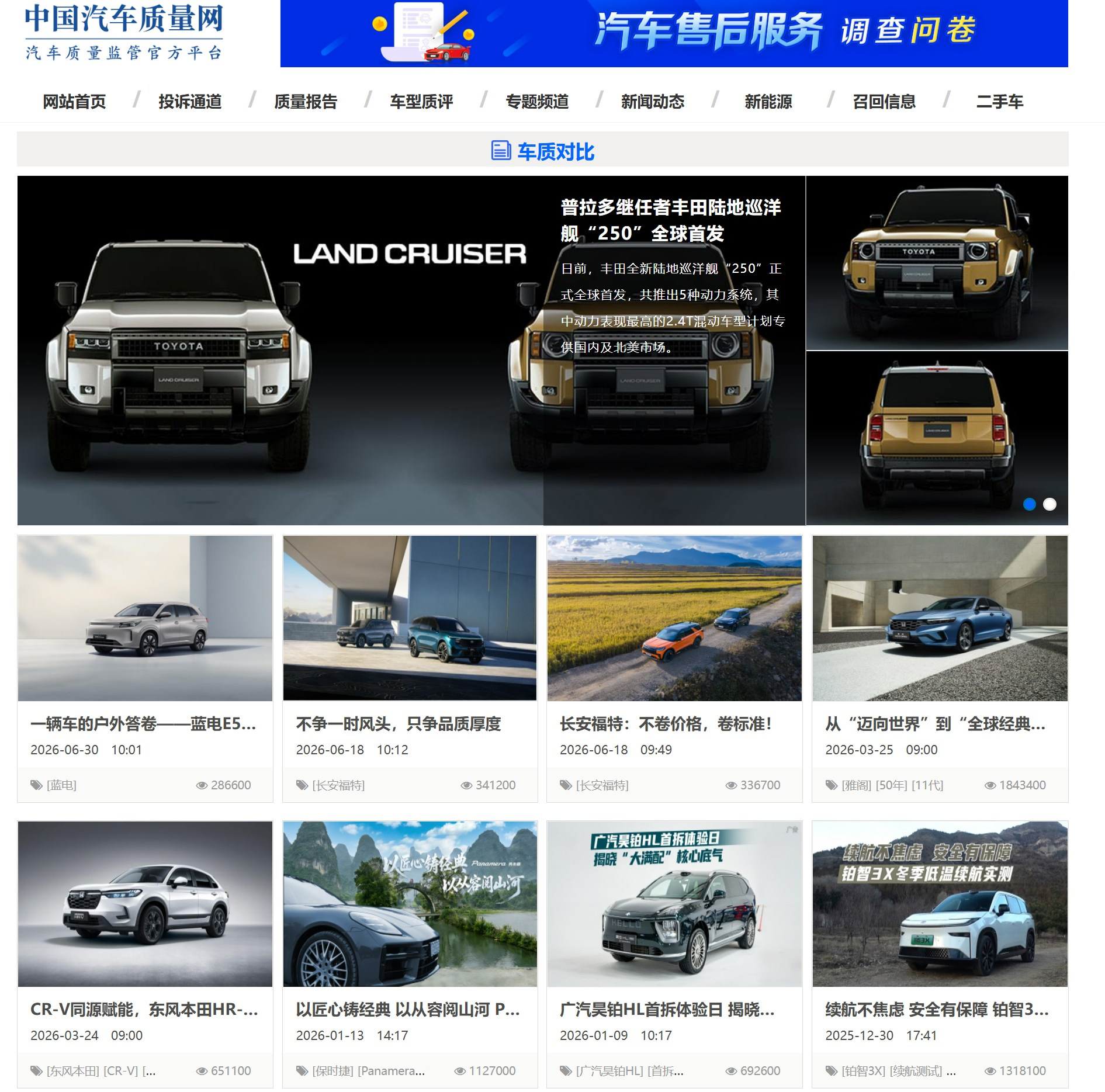
An official platform with real complaint data in hand publishes automaker press releases in its "Vehicle Quality Comparison" column. At the same time, on its complaint platform, a Changan Ford Explorer owner is complaining about a dispute over three-guarantee transportation compensation, with the 4S dealership and the manufacturer giving inconsistent accounts, and a Honda Fit owner is complaining that "the manufacturer evades responsibility and pushes it to the 4S dealership."
This inconsistency between backend data and front-end content is more serious than simply "not updating." It means that the image this platform presents to the public and the information it actually possesses are clearly disconnected.
Commercial Media "Filling In" and Regulatory "Lag"
Back to the Zunjie V800 incident.
On October 8, 2026, Dongchedi released a test video: it bought three Zunjie V800s in a row, and in a 100km/h-0 emergency braking test, the brake pedal brackets all fractured, with highly consistent fracture locations and forms. JAC Motors' stock price hit the limit down that day.
Three days after the incident escalated, on October 11, People's Daily published a commentary titled "Four Departments Join Forces to Say No to 'Rush-Built Cars'." It wrote: "Although the incident still awaits an authoritative investigation conclusion, one thing is indisputable: a car's brake pedal should absolutely never 'fracture' while driving!"
On the same day, the Ministry of Industry and Information Technology and three other departments issued the "Notice on Further Strengthening the Management of Automotive Product Innovation Design and R&D Test Verification (Draft for Comments)," requiring newly declared products to complete tests including comprehensive reliability and durability, structural reliability, and software function reliability; the environmental adaptability verification period must be no less than 1 year and must include "two winters and one summer" testing; and the reliability verification test mileage must be no less than 30,000 kilometers.
In this chain, what can be seen is that commercial media defined the problem (Dongchedi's test), central media set the tone (People's Daily's commentary), and four departments issued rules (the draft for comments). Yet that official automotive quality regulatory platform, which should be the most authoritative, did not make a single sound throughout the entire process.
This is not the first time it has been "absent." The way it is absent precisely exposes a structural characteristic of the defective product recall system: the design logic of this system is reactive and passively responsive. It requires consumers to submit complaints, requires accumulation to the point of "general existence," and requires completing the process of evaluation, enterprise confirmation, and defect analysis. In this process, it will not, and should not, comment on a single event.
But the problem is that when commercial media has already used visualized test videos to fulfill the function of "public safety warning," the public's expectation for an "authoritative voice" has already been generated. And the authoritative response at the institutional level appears slow because of procedural requirements. This speed gap is the root of the misaligned pattern of "commercial media defines the problem, the official platform records the problem, and central media ultimately sets the tone."
This Was Not Exposed Only by This Incident
If the view is extended, one finds that this structural misalignment has always existed.
Xiao Lingyun, director of the Industrial Products Institute of the Defective Product Recall Technology Center, disclosed a set of data at the 2026 TEDA Automobile Forum: as of the end of 2025, China had cumulatively implemented 121 million vehicle recalls, of which 53% were triggered after regulatory authorities initiated defect investigations, while the other half were voluntary recalls by enterprises.
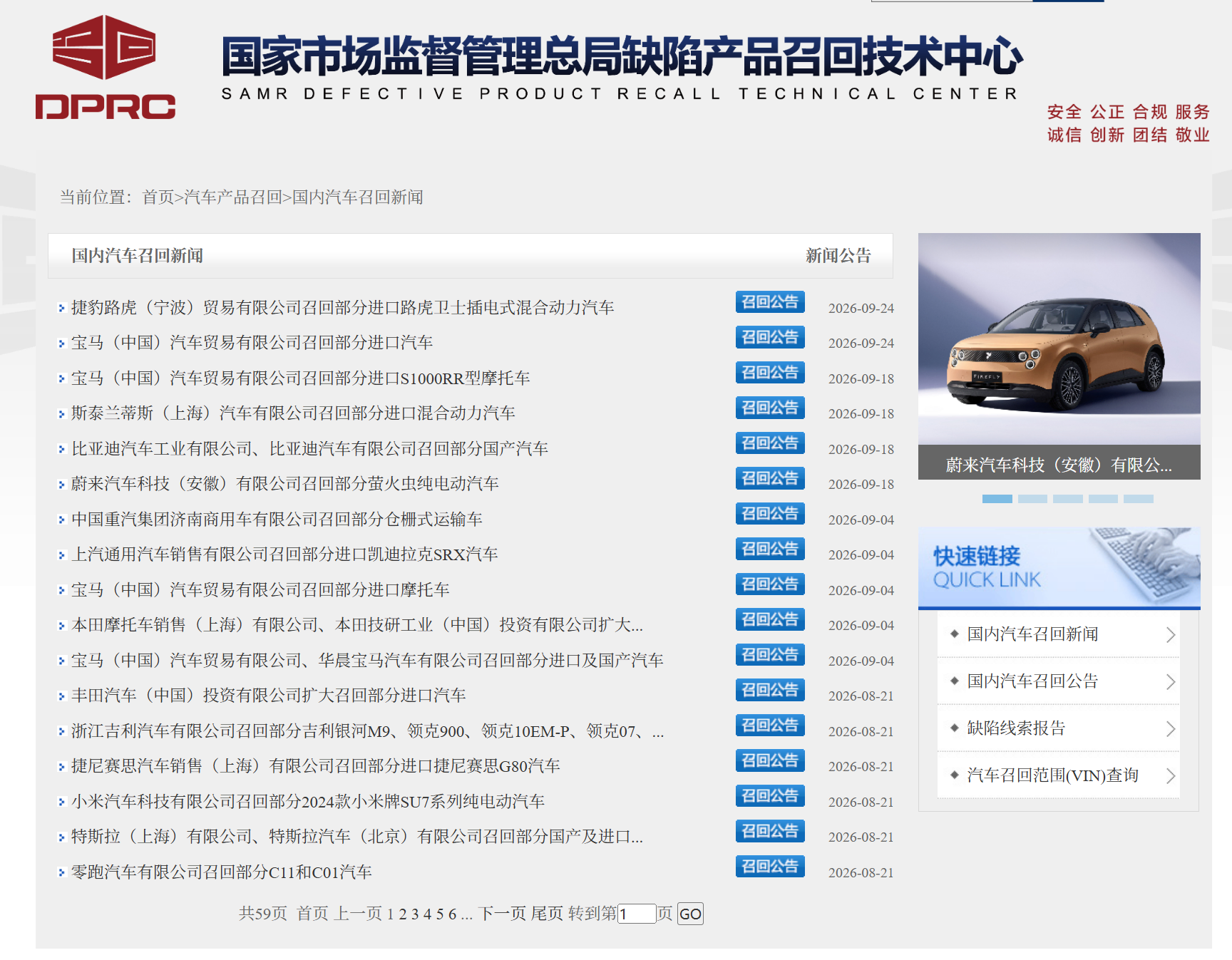
These data show that the recall system itself is operating. But at the same time, Xiao Lingyun also admitted that in the face of safety defects brought by new technologies, the traditional process of "consumer complaint—regulatory investigation—enterprise recall" has lag. To this end, regulators are introducing a "sandbox mechanism," building extreme stress test environments outside real user scenarios to discover risks through proactive testing. At present, about more than 2 million vehicles have avoided accidents after large-scale application through improvements under sandbox regulation.
Regulation is striving to move forward. The new rules from four departments requiring 30,000 kilometers of reliability verification are also an attempt to move the defense line from "post-recall" to "pre-verification." But the signals of these reforms often appear in the form of policy documents, rather than being conveyed in a way the public can perceive.
If China Automotive Quality Network could withdraw resources from commercial reviews and automaker press releases and do one thing it truly cannot be replaced in—deep disclosure based on complaint data—its sense of presence would be completely different. For example: the concentration trend of complaints for a certain model in a certain fault type, the complaint distribution of vehicles in the same batch, and changes in the resolution rate after complaints are accepted. Only it has this data, and no commercial platform can replicate it.
But it has not done this. It has left its content space to commercial cooperation and consumed its credibility on "reviews" and "comparisons" unrelated to its core function.
The Value of a Platform Lies in What It Does Not Do
Back to the sense of rupture at the beginning.
The data on the complaint platform is real, vivid, and of public value. I casually looked through the 120 new complaints on October 10: there was sudden power loss at high speed, battery leakage, and steering failure. If these leads accumulate to a sufficient number, they may trigger a defect investigation and may affect recall decisions. Even during the weekend when I was writing this article, I saw another batch of new complaints appear. This also objectively proves how urgent consumers' demand for this kind of regulatory platform is.
However, compared with growing consumer demand, the website's homepage headline is from 2024, reviews are from 2022, and vehicle quality comparisons are automaker press releases. If a consumer visits this website for the first time and sees this content, it is hard to believe that behind it there is a defect clue database still in operation.
The value of an official platform lies to a large extent in what it does not do. It does not do commercial reviews, does not publish automaker press releases, and does not participate in public opinion hype. It only collects defect clues and analyzes quality data. This is where it is irreplaceable. Once it starts doing those things, it is no different from commercial media, and it does them worse.
It has not "disappeared from the internet"; it is dormant at the front end and operating at the back end. Those "accepted by manufacturer" records are the evidence that it is alive. But whether "acceptance" can become "resolution" or "recall" is the part truly worth watching.
And before that, it needs to first figure out one thing: what kind of face should an official platform show to the public? Should it be an "automotive media outlet" with outdated content and chaotic standards, or a silent but reliable entry point for defect clues? It can only choose one of these two paths.